
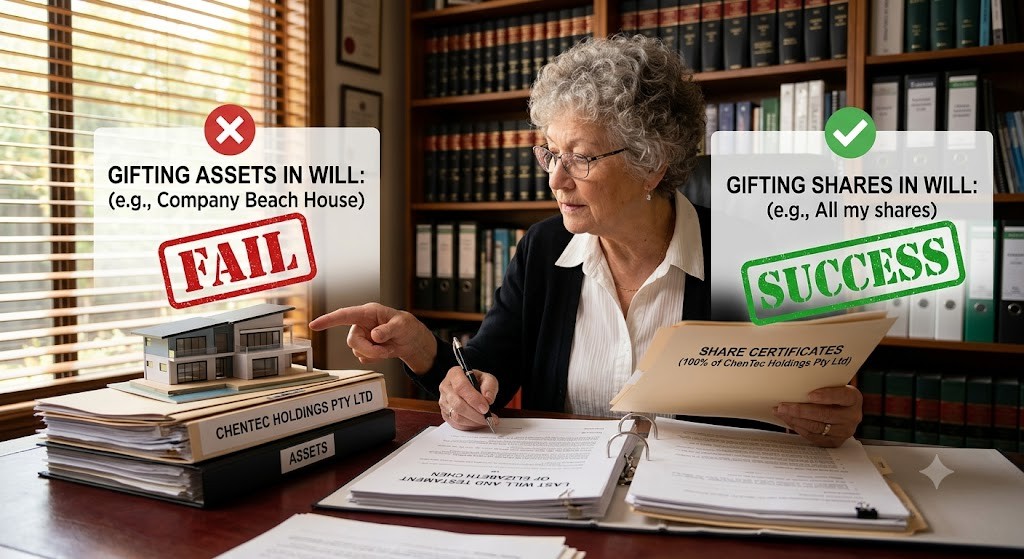
You can gift shares that you own. But you cannot gift the assets in the company. The company owns the assets, not you, the shareholder.
No. But you can gift the shares. Here is an example:
Dad owns all the shares in BeachCo Pty Ltd. BeachCo owns the holiday home. Around the kitchen table, everyone calls it ‘Dad’s holiday home’. Dad pays the bills. Dad books the repairs. Dad tells the children when they can use it over the summer.
So Dad writes a Will and says:
‘I give my holiday home to my daughter.’
Seems reasonable, right?
Dad owns the company. The company owns the property. Therefore, Dad owns the property.
This is wrong. Dad does not own the asset. He can therefore not give it away.
He can give away the shares as a shareholder. But he cannot give assets away that belong to another person. In this example the person is a company.
Can a Will gift company property? Ireland v Retallack
That is the trap in Ireland v Retallack [2011] NSWSC 846. Dad controlled almost all the shares in Glengowan (Moorilda) Pty Ltd. The company owned land. His Will tried to give that land away.
The Will also gave the executor power to ‘manipulate’ estate and company assets to make the gift happen.
I love that word: manipulate. As if company law melts away when you say it with enough confidence.
The problem was simple. Dad owned the shares. He did not personally own the land. The company owned the land.
The Court was able to rescue the gift because the Will gave the executor sufficient control over the shares to ensure the company did what the Will intended. But do not celebrate too early.
That rescue required a Supreme Court construction suit. Lawyers. Accountants. Evidence. Argument. Cost. Pembroke J criticised the professional feeding frenzy and said the estate was being treated as a ‘milch cow’.
That is not estate planning. That is litigation with a pulse.
Company assets are not shareholder assets
A company is a separate legal person. This is the old rule from Salomon v A Salomon & Co Ltd [1897] AC 22. It is still the backbone of Australian company law.
And the point is even sharper in Macaura v Northern Assurance Co Ltd [1925] AC 619. A shareholder did not own the company’s timber, even though he owned all the shares. The company owned the timber.
The Corporations Act 2001 (Cth) s 124 says a company has its own legal capacity. Dumbed down: the company can own property in its own name, just like a person can.
The Corporations Act 2001 (Cth) s 198A says the company’s business is managed by or under the direction of the directors, unless the company constitution says otherwise.
So there are two different things:
- the shares, which the shareholder owns; and
- the holiday home, farm, trucks, bank account, and business assets that the company owns.
Your Will can give away the shares. Your Will cannot give away assets that belong to the company.
It does not matter that Dad is the sole director. It does not matter that Dad owns every share. It does not matter that the accountant calls the company ‘Dad’s company’.
If the holiday home is owned by BeachCo Pty Ltd, then BeachCo Pty Ltd owns the holiday home. Dad owns the shares in BeachCo Pty Ltd.
Leaving shares in your Will controls the company
This is the bit people miss.
Leaving shares in your Will is powerful. The shareholder can usually vote. The shareholder can usually appoint and remove directors. The shareholder can control who sits at the board table.
Under Corporations Act 2001 (Cth) s 203C, a proprietary company can remove a director by resolution, subject to the company’s constitution. Under Corporations Act 2001 (Cth) s 201G, a company may appoint a person as a director by a resolution passed in a general meeting, again subject to its constitution.
And directors control the company’s assets.
So you do not need to pretend the holiday home is Dad’s personal asset. You leave the shares to the right person. That person becomes the shareholder. As shareholder, they can hire and fire directors. Through the directors, they control what the company does with the holiday home.
That is the correct pathway. Shares first. Control second. Company assets third.
Company shares on death: Corporations Act and the Constitution
The company constitution matters. The Corporations Act 2001 (Cth) s 140 says the constitution has effect as a contract between the company and each member, between the company and each director and secretary, and between members themselves.
The replaceable rule in Corporations Act 2001 (Cth) s 1072A deals with the transmission of shares on death. Dumbed down: if a shareholder dies, the personal representative may become the person recognised by the company as having the shareholder’s interest.
But do not stop there. The Will, company constitution and company succession plan should all speak to each other. Otherwise, the family discovers after death that the Will says one thing, the company documents say another, and the bank says, ‘come back with a court order.
What happens if your Will gifts company property?
Dad dies. His Will says, ‘I give my holiday home to my daughter.’
But the holiday home is owned by BeachCo Pty Ltd.
The executor now has a problem. The executor cannot simply transfer the holiday home. It is not Dad’s asset. It is the company’s asset.
The directors must still obey the Corporations Act 2001 (Cth). The company constitution still matters. Tax and duty still matter. The other shareholders, if any, still matter.
The family then pays lawyers to explain something that should have been fixed before death.
The lawyers smile. The accountants smile. The beneficiaries do not.
Gift shares in your Will, not company assets
If you want your daughter to control the company, gift the shares to your daughter.
If you want your son to control the company, gift the shares to your son.
But shares are not the same as direct ownership of the company’s assets. A share is a bundle of rights. It usually gives voting rights, dividend rights and rights to capital if the company is wound up. It does not make the shareholder the owner of each company’s assets.
If you want control to pass cleanly, deal with the shares, the company constitution and director succession before you die.
Start with succession planning in a company. This is where you deal with who controls the company when the shareholder or director dies.
Do not try to use your Will as a corporate restructuring kit. Your Will is not a magic wand. Your Will gives away assets you own. It does not pierce the corporate veil because you used emotional language.
Company succession planning checklist before death
- Stop saying ‘my property’ when the company owns it. Language trains the brain. Bad language creates bad estate planning.
- Get the ownership list. Ask your accountant: which assets are owned personally, by the company, by a trust, or by an SMSF?
- Fix the company documents. Old company constitutions, stale director rules and missing succession machinery create pain when a key person dies.
Company succession and death toolkit
Company assets in a Will: do not rely on luck
Someone will say: ‘My uncle left a company asset in his Will and it was fine.’
Maybe the asset was actually owned personally. Maybe the family quietly fixed the problem. Maybe everyone got lucky.
I do not build estate plans on luck.
The law is clear. Your Will can gift what you own. If you own shares, gift the shares. If the company owns the asset, respect the company.
Do it properly. Do it once. Then sleep well.
This article was prepared by Professor Brett Davies and Legal Consolidated law graduate Jiale Li (Charlie), JD (Monash University), BCom (ANU).