


Divorce Protection Trust in your Will – stop step-children taking your money at death
Your daughter-in-law knows you have money and that you are old. She tolerates living with your son a little longer. You die. She immediately leaves your son. She asks the Family Court for half of your son’s inheritance.
When you build your tax-effective Wills on our website, the trusts available in your Wills include:
- 3-Generation Testamentary Trusts – to reduce de facto death duties such as Capital Gain Tax, Transfer (stamp) duty and income tax
- Superannuation Testamentary Trusts – remove the 15% or 30% (plus Medicare) tax on your Superannuation when your Superannuation goes to adult children
- Protective and Maintenance Trusts – if a child, grandchild or beneficiary is under the Age of Majority
- Bankruptcy Trusts – if a beneficiary is bankrupt
- Divorce Protection Trusts – if a beneficiary suffers a split-up from a spouse or de facto partner
- Considered Person Clause – to stop people from challenging your Will
- Special Disability Trust – child keeps getting Centrelink benefits after you die
- Able to sell your parents’ home two (or even three years) after their death – CGT-free
How does the Divorce Protection Trust work in my Will?
The Divorce Protection Trust seeks to delay or stop capital and income going to the beneficiary who is suffering a divorce or separation. It reduces the opportunity for the Family Court to get its hands on your money.
The Family Law Act gives the Family Court power over third parties. See also the Federal Court case in the West Point collapse.
In a divorce, the Family Court examines how the assets came into the trust. It considers who gave the money to the trust in the first place.
1. If assets come from one of the couples during the relationship and are then put into a trust, the assets are considered part of the marriage. The Court is free to order the transfer of the assets to your child’s ex-spouse.
2. However, this may not apply where the money comes via a Will. Instead of your divorcing child putting money into a trust, you are the one putting the money into the trust (via a Divorce Protection Trust). It is arguably different when the person’s parents gift their assets into a Divorce Protection Trust.
The Family Court can disregard trusts set up to limit its reach as a sham. However, that relates predominantly to one of the separating couples taking their money and trying to hide it in a trust. This is not the case here. This money is not from one of the separated couples. Rather, the money is from the parents of one of the separated couples. The money is from an inheritance of a parent, grandparent or great-grandparent. The Divorce Protection Trust is designed so that the inheritance never becomes an asset of the marriage. It is designed to be a trust for the benefit of many beneficiaries, not just the separating person.
Divorce Protection Trusts more resilient to Family Court attacks
A Divorce Protection Trust is one of the many types of Testamentary Trusts we put in your Will. There are not many cases on Testamentary Trusts. However, in our experience, the Family Court is less likely to break open a trust in a Will and less likely to plunder testamentary Trusts. The Divorce Protection Trust provides additional safeguards against escaping the Family Court. This is over, and above all the other types of trusts, we put in your 3-Generation Testamentary Trust Will.
Should brothers be trustees of each other’s Testamentary Trust in their deceased dad’s Will for asset protection and divorce?
Q: Yesterday, as the financial planner, I completed a tax-effective Will on Legal Consolidated’s website. As you requested, I sent a copy to both the client’s accountant and the commercial lawyer. The 3-Generation Testamentary Trust names both sons as executors. They receive 50% each. The commercial lawyer wants the option for each brother to be the respective trustee of the other’s death trust. This is so that the trustee is not also the primary beneficiary.
But the commercial lawyer does not want to force this. He wants the brothers to make that decision after Dad dies. This is because the brothers may not like each other, or a brother could be dead. We need to stay flexible.
A: The commercial lawyer is smart. And I completely agree. You will be happy to know that the 3-Generation Testamentary Trust Will allows that approach (and many other versions of it) to be followed. The 3-Generation Testamentary Trust Will allows this excellent strategy. It can be put in place after the Will-maker’s death.
As an extra layer of protection, our 3-Generation Testamentary Trust Wills also contain Bankruptcy Trusts, Divorce Protection Trusts and Special Disability Trusts.
The weaponry to protect your clients is built into the 3-Generation Testamentary Trust Will, which can be used as their own lawyer, financial planner, and accountant’s advice after the Will maker is dead.
The 3 great unknowns when making your Will to escape the family court
- Dad’s day of death
- what assets he will own at that time
- changes to the law. Tax, superannuation, family law, and bankruptcy rules continuously change.
So, flexibility in a Will is the greatest gift that a dad can give. The most flexible Will is the 3-Generation Testamentary Trust Will.
Dad dies. Son divorces 3 years later – Bernard v Bernard
In Bernard v Bernard [2019] FamCA 421, the husband and wife married in 1988. They separated in 2015. They divorced in 2017. In 2012, the husband’s father died. He leaves his estate equally to the husband and the husband’s sister. This is under two discretionary testamentary trusts. The husband is the trustee of his sister’s trust. His sister is the trustee of his trust.
Each is the primary beneficiary of their own trust. Each trust has many potential beneficiaries. These include the spouse, children and grandchildren of the primary beneficiary. The facts are: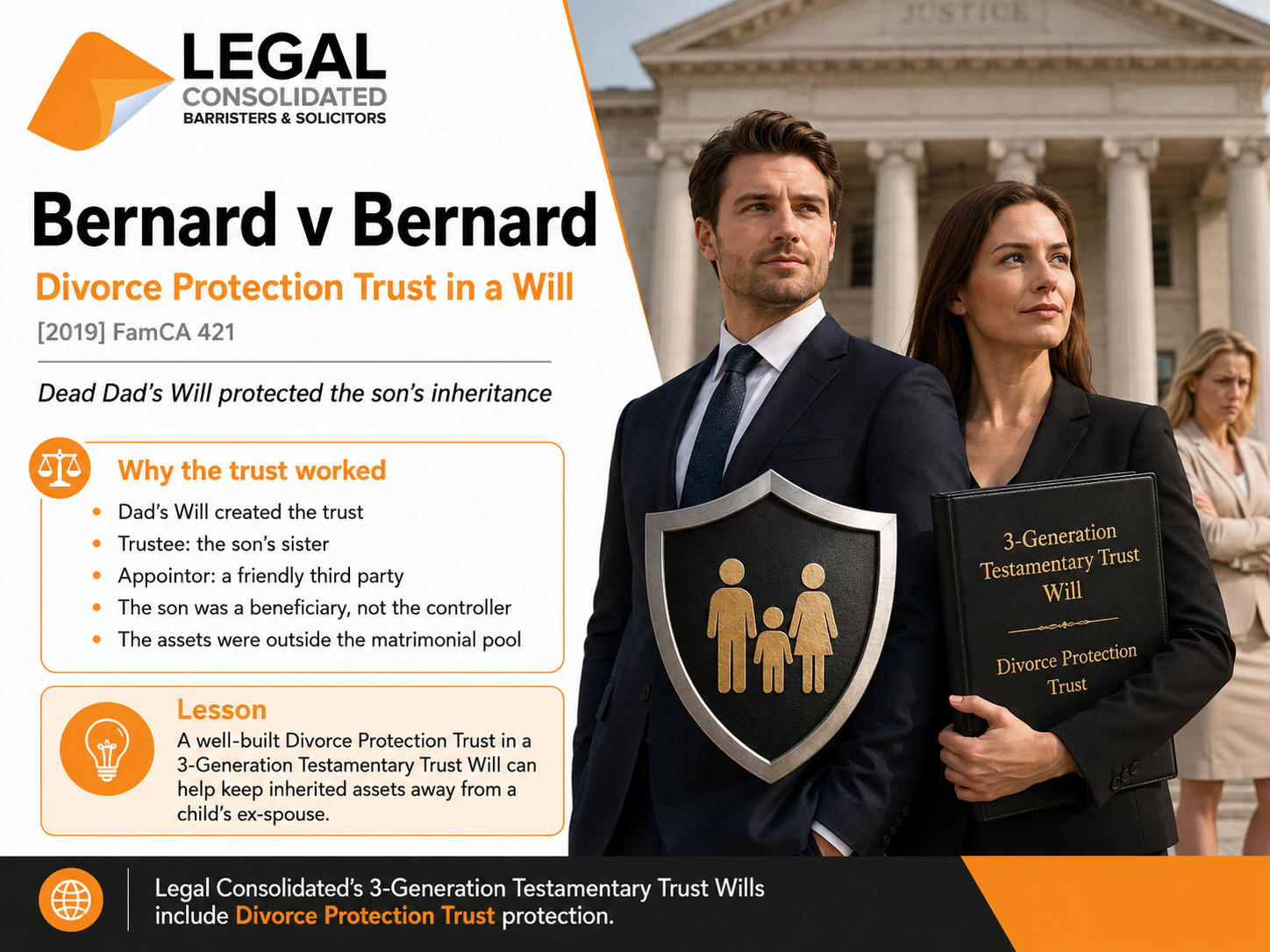
- Dad dies.
- The son uses the Divorce Protection Trust in the dead Dad’s Will.
- Three years later, the son divorces.
Testamentary Trust provides spouse protection in a relationship breakdown. Bernard v Bernard facts:
- Divorce Protection Trust: set up in Dad’s Will
- Divorce Protection Trust name: they used the divorcing son’s name (pretty irrelevant, I know, but the family court is psychological warfare)
- Primary Beneficiary: divorcing son
- Appointor: friendly third party (often the accountant or financial adviser)
- Trustee: divorcing son’s loving sister
- Beneficiaries: the usual suspects, including the divorcing son, his children, spouses (including the divorcing wife), distant relatives, charities, etc…
Wife tries to defeat Will’s Divorce Protection Trust in Bernard
The wife argues that:
- The divorce protection trusts mirror each other.
- The husband and his sister have the same rights and obligations as trustees of each other’s divorce protection trust.
- They use the two trusts to operate a partnership.
- The husband controls his own trust, as does the sister.
- The husband controlled his own trust, and this control equated to ‘property of the marriage’.
- According to the court, in paragraph 74, the wife’s argument is that:
- ‘The reality is the husband and his sister operate their business as a partnership and that their trusts are mirrors of each other [with both] having effective control of the assets in their trusts and therefore those assets are matrimonial property of the husband’.
- In paragraph 81, the Judge states that the ‘facts do not support such a finding’.
Bernard v Bernard Decision: Good news: Divorce Protection Trust is not part of the matrimonial pool.
The Court held that the Divorce Protection Trust was not part of the matrimonial pool. The divorcing wife could not touch the assets. This is because:
- Settlor (Will-maker): was dead dad, not the divorcing son.
- The trusts were established from the assets of the late father’s estate, not from property acquired by the husband before or during his marriage to the wife. The court states in paragraph 66:
‘… the husband does not have legal title to any asset of the trust, nor does he have any power to appoint a trustee or appoint the assets of the fund to a beneficiary. He is a mere beneficiary, albeit described as a primary beneficiary. The husband is dependent upon the trustee of his trust to distribute income, accumulate income, and the trustee has complete discretion in determining any distributions made by the trust.’
- Trustee: was the sister, not the divorcing son
- Appointor: was not the son
- Power and control: remained solely with the Appointor and Trustee (the sister). The husband is a mere beneficiary of his trust. He had no more than a right to due administration and consideration. He has no control over his sister to procure a distribution or appointment of the trust’s assets in his favour. As the trustee, his sister owed fiduciary obligations to all beneficiaries, not just her brother. In paragraph 96 the Court quotes Harris v Dewell [2018] Fam CAFC 94:
‘Control is not sufficient of itself. What is required is control over a person or entity who by reason of the powers contained in the trust deed can obtain or effect the obtaining of a beneficial interest in the property in the trust.’
- Primary Beneficiary: while the husband was a primary beneficiary, this of itself created no legal title to the trust property
- Sham? There was nothing to suggest that the structure of dead Dad’s Will was a sham
- Sister had her own Divorce Protection Trust in her dead dad’s Will: that is fine. Having more than one Divorce Protection Trust in a Will is acceptable
- Good records: the court was impressed with the accountant for his excellent records, resolutions and tax returns. Each trustee was ‘scrupulous’ in filing separate tax returns, making resolutions under the trust deed and avoiding the mingling of trust assets. Professor Brett Davies stated
“rarely does the Court see a family law matter where tax returns and disclosure is so up-to-date and thorough.”
Was the trust merely for the benefit of only the divorcing son?
Although this is not directly mentioned in the case, the Divorce Protection Trust is not for the sole benefit of the divorcing husband. It is not a ‘bare trust‘.
Instead, it is a trust from which many generations can benefit. That is one of the four requirements we put in your Divorce Protection Trust.
What if there is only one beneficiary and the list of Executors is exhausted?
What if the sole beneficiary lacks capacity?
The 3-Generation Testamentary Trust Will states that the role of the Appointor is initially under the control of each Primary Beneficiary, as defined in the 3-Generation Testamentary Trust Will.
However, the Primary Beneficiary must have overcome four hurdles:
- reached the Age of Majority
- not be divorced
- not be bankrupt
- be of sound mind.
Having satisfied the hurdles, the Primary Beneficiary may establish as many testamentary trusts as they wish for their part of the estate. They can appoint trustees and appointors as they see fit (e.g. a brother, a company or themselves). If you have to narrow estate planning down to one word, it is ‘flexibility’. The 3-Generation Testamentary Trust Will is very flexible. Therefore, after you die, each primary beneficiary will plot and plan with their accountant, financial planner and lawyer to set up the trusts that best suit that purpose. In your Will, you gave them a lot of discretion; this is a great gift from you, the Will maker.
However, if the Primary Beneficiary can not currently satisfy the hurdles, the 3-Generation Testamentary Trust Will states that the Executor assumes the role of Appointor in trust for the Primary Beneficiary until capacity is restored. If the chain of Executors is exhausted. For example, if the executor is dead or lacking mental capacity, the definition does not extend the role to the Primary Beneficiary’s family.
However, an equitable maxim is that a ‘trust will never fail for lack of an executor’. The Court will appoint executors who act in the Primary Beneficiaries’ best interest. In such circumstances, the Primary Beneficiary’s family would usually step in to ensure the trust’s administration continues.
Who becomes the Appointor once the last Executor dies if the sole beneficiary lacks capacity?
According to the Will, when the Primary Beneficiary lacks capacity, the Executor assumes the role of Appointor in trust for the Primary Beneficiary and must act solely in the beneficiary’s best interests. If the chain of Executors is exhausted—meaning the last Executor dies—the legal representative of that Executor assumes the role. Under the laws of each Australian state and territory, if no legal representative is available, the court will appoint an Executor.
Does the Primary Beneficiary’s family take over as Executor if there is no Executor and the Primary Beneficiary lacks mental capacity?
Usually, yes. However, it is not automatic; a Court order is required to confirm the appointment of the Primary Beneficiary’s family as the Executors.
If multiple Executors act jointly, do they all serve as Appointors?
Under the Will and by law, executors must always act together. If the Primary Beneficiary cannot satisfy the hurdles, then the Executors act jointly. They serve collectively as Appointors, always in the best interests of the relevant Primary Beneficiary.
However, if the Primary Beneficiary has satisfied the hurdles, the Executor’s role is typically brief until Probate is granted, and the Executor transfers the assets as directed by the Primary Beneficiaries. Once that transfer is complete, the Executors have fulfilled their function. This is usually within three months, and then the Executors have finished their job and gone home.
However, if the Primary Beneficiaries have not met the necessary conditions, the Executors will continue in their role. In such cases, their role may transition from Executor/Trustee to just Trustee. At all times, their duty to act in the best interests of the Primary Beneficiaries remains in force from the moment of your death.
To help with Divorcing children: Young and Vulnerable Children tool kit
Free resources to help protect young and vulnerable children:
- Vulnerable children in Wills – free training video
- Loans to children – in case your children, grandchildren or beneficiary divorce or go bankrupt
- Divorce Protection Trusts in Wills – if a beneficiary, child or grandchild separates
- Making Wills for Your Children
- Special Disability Trusts – for your family members who suffer mentally after you die
- Elder Abuse – protects the children as well as people with dementia
- Life Estates do NOT protect children
- Child renounces a gift or Family Trust distribution for Centrelink and stops the Trustee-in-Bankruptcy
- Children paying 32% on your super when you die
- Only disabled children can take your SMSF Reversionary Pension
- Parent dies, child pays 66% tax
- Dad’s Will: child vs charity
- Son loses the farm to his two sisters
- Disabled dad has $9m, two children and no Will
- Court rewrites disabled Dad’s Will to protect children
For divorce and asset protection, should brothers control each other’s 3-Generation Testamentary Trusts?
Q: I completed a Legal Consolidated tax-effective Will yesterday. The accountant has forwarded it to their commercial solicitors, as you suggested.
The 3-Generation Testamentary Trust Will names both sons as executors. Each receive 50%.
The commercial lawyer believes that each brother should be the respective trustee of the other’s death trusts. So, that the trustee is not also the Primary Beneficiary.
A: The commercial lawyer is smart. And I completely agree.
And you will be happy to know that the 3-Generation Testamentary Trust Will allows that strategy (and many other versions of it) to be followed. It has sufficient flexibility to allow this excellent approach which is put in place after the Will maker’s death.
Further, to buttress the protection our 3-Generation Testamentary Trust Wills also contain Bankruptcy Trusts, Divorce Protection Trusts and Special Disability Trusts.
The weaponry to protect your clients is in the 3-Generation Testamentary Trust Will. And available to be used as they see fit as their lawyer, adviser and accountant advise after the Will maker is dead.
It may be the case that the brothers hate each other when dad dies. Or a brother is dead.
This is why the number one requirement of a Will is flexibility. You do not know the hour of your client’s death. You do not know what assets the dead person will have. And we have no idea of the laws of the land. Tax, superannuation, family law and bankruptcy are forever changing. The greatest gift that a Will can give the children is ‘flexibility’. The most flexible Will is a 3-Generation Testamentary Trust Will.
For a Divorce Protection Trust should the other child be a trustee?
Q: I have two children. Is it better protection if, after I am dead, they are the Trustee or Appointor (Primary Beneficiary) of the other Testamentary Trusts? Do you recommend that each of the children be the trustee for the other’s Testamentary Trust?
And, should each of the children remain as Appointors of their own Testamentary Trusts?
For example:
- Bill is the Trustee of Sue’s Trust. Sue is the Appointor and Primary Beneficiary of this Trust.
- Sue is a Trustee of Bills Trust. Bill is the Appointor and Primary Beneficiary of this Trust.
I am aware of the case Bernard v Bernard. But I would like to get your practical perspective based on your Divorce Protection Trust. This is because Legal Consolidated’s Divorce Protection Trust goes one step further than the Testamentary Trust in Bernard’s case. It automatically removes the power of the Primary Beneficiary when attacked. This is very strategic.
A: The Divorce Protection Trust is designed to operate even if there is only one beneficiary in your Will. For example, your only child is Fred. When you and your spouse both die, Fred is the sole executor and the sole Primary Beneficiary. That is fine.
The wealth in your Will is left not just to Fred. But for 100s of other potential beneficiaries. The way that Legal Consolidated drafts the Divorce Protection Trust is that Fred loses control if there is activity or threat by his partner, spouse or mistress. Another person, other than Fred, takes control. That may be Fred’s company, friend or relative.
But of course, the more you muddy the water, as they did in Bernard’s case the harder it is for the divorce courts and bankruptcy courts to hand over your hard-earned money in your Will to your child’s divorcing partner. So mixing up the Trustee position is common. And the fictional Fred can do that by interposing a corporate trustee, friend or relative to hold the trusteeship. The Legal Consolidated Divorce Protection Trust authorised and allowed that strategy. And Fred may well set it up that way after you are dead.
However, while the Divorce Protection Trust allows it – because it is full of flexibility – I find the strategy of having another person as the Appointor to not be the best. If you are the Appointor (or rather Primary Beneficiary, at the moment of death) then the Appointor controls the money.
If Fred is bent on removing himself as an Appointor, then his accountant would look at making a company an Appointor. Like having a company as trustee of your SMSF, the corporate trustee avoids having to transfer the titles. As would be the case if the Primary Beneficiary used a human to be the trustee of one of their Testamentary Trusts.
If a corporate trustee is used for each of the children’s Testamentary Trusts:
The beauty of the Divorce Protection Trust is its flexibility. And the fictional Fred will be guided by his accountant after you are dead. This is on how to best take advantage of the Divorce Protection Trust.
When does the Divorce Protection Trust operate?
The Divorce Protection Trust sits dormant in the dead person’s Will until needed. The Divorce Protection Trust activates for the benefit of the married person and that person’s children and grandchildren. (This is your divorcing child, then their children and their grandchildren). The assets in the Divorce Protection Trust are provided by the parents (you), not the married person (e.g. your child). There is higher protection from the Family Court because of this. See, for example, Bernard v Bernard. The money is not from the divorcing couple. It is from an external person – the Will-Maker.
Your descendants (children, grandchildren and great-grandchildren) are beneficiaries of the Divorce Protection Trust but not owners of the assets.
What if a descendant controls the trust? This is where the descendant is the sole trustee or appointor. (This position of power controls the trust.) The Family Court states that the ‘controller’ is also the ‘owner’.
In these circumstances, a court may decide that it has the power to make an order affecting assets held by the trust. For example, the Court orders the transfer of the trust assets to the former spouse of the controller or a trustee in bankruptcy.
However, the Divorce Protection Trust removes that person’s power to control the trust while they are suffering the separation. This removes control.
Who is the new Trustee of the Divorce Protection Trust?
The Primary Beneficiary under attack is automatically removed from all positions of power for their testamentary trusts. This includes the Appointor and Trustee positions. The power passes to the other executors named in the dead person’s Will – or their next of kin if they are also dead – or if there are none then blood relatives of the Primary Beneficiary. Of course, the Primary Beneficiary can always amend the Divorce Protection Trust to change this.
For example, widower Dad has 3 children. He leaves them everything and makes them the executors. Dad dies leaving 33 1/3% of the assets to his son Gavin. Ten years after dad dies Gavin separates from his hot trophy wife. Immediately his two other siblings are automatically in control of all his testamentary trusts that Gavin got from his Dad. However, one is dead and their children take on the job. They must act only in Gavin and his children’s best interests. So the siblings and their children can’t benefit themselves from the trust.
The Divorce Protection Trust benefits the current and succeeding generations. It not only protects your children. It also protects your grandchildren and grandchildren, for up to 80 years after you die. This helps protect the assets from the Family Court.
Why does the family court attack assets you ‘don’t own’?
The matrimonial pool includes:
- assets held in the parties’ individual or joint names
- businesses
- inheritances received in their personal names
- superannuation
- assets held within trust structures.
Financial resources typically include trust income or capital that the parties access.
Not all testamentary trusts protect against the powers of the Family Court. The Court has wide powers:
- power to make orders against trustees of trusts
- power to make orders that direct or alter the rights, liabilities or property interests of a third party
- power to attribute a trust as a financial resource of a party to the marriage and adjust the matrimonial pool available for distribution accordingly.
Can a 23-day marriage still trigger the Family Court? Hsiao v Fazarri
Consider Hsiao v Fazarri [2020] HCA 35. The husband and the second wife began an intimate relationship before he separated from his first wife. Not ideal estate planning. Not ideal cardiac care either.
The relationship continued for years, but the parties lived in separate homes. The Court found that they did not start a de facto relationship. Then they married. The second marriage lasted 23 days.![Hsiao v Fazarri [2020] HCA 35 short relationships show that the Family Court will immediately consider a dead persons assets](https://legalconsolidated.com.au/wp-content/uploads/my-deceased-assets-are-lost-when-my-children-divorce.png)
The husband was wealthy. His assets were about $20m before his property settlement with his first wife. The young second wife had far fewer assets, but she had leverage. Romance does that. So does a hospital bed. The husband bought a Melbourne property. He first gave the second wife a 10% interest. Later, while in hospital with a suspected heart attack, he signed a transfer giving her a further 40%. That made them joint tenants.
After the 23-day marriage ended, the second wife wanted more. She argued about the property, the deed of gift and the extra 40% interest.
The second wife did not get the windfall she wanted. The Court ordered her to transfer her interest in the property back to the husband. She ended up with only $430,000. That sounds like a small result against a wealthy husband. But do not miss the point.
A 23-day marriage still opened the Family Court door. It still led to years of litigation. It still reached the High Court. It still put gifted property, joint tenancy, deeds of gift and relationship history under a microscope.
Similarly, if you die today, your children’s spouses have immediate access to your inheritance without a Divorce Protection Trust in the Will.
Does a Divorce Protection Trust in your Will protect your children BEFORE you die?
The Divorce Protection Trust protects your assets AFTER you die. It not only protects your children, grandchildren and great-grandchildren, but it also protects all beneficiaries and their offspring. It is not just for your children. The benefit is for all beneficiaries – whether related to you or not.
But, in this instance, your children (or beneficiaries) are divorcing, and you are still alive. Your Will does not operate until you die. And you can change your Will. But the Family Court can still consider the ‘potential’ gift. The Family Court, therefore, gives more money to the ex-in-law. This is on the basis that your child gets some money under your Will, at a later time when you are dead!
What is a Prospective inheritance?
A prospective inheritance is an anticipation of getting assets in the future. The Will maker may change their Will or go bankrupt. Therefore, the courts often exclude prospective inheritances from the divorcing couple’s property pool. But it may consider such ‘expectancies’ either as a financial resource (s 75(2)(b)) or as ‘any other matter that is relevant’ (s 75(2)(o)).
Prospective inheritances are not marital property. This is because they have not been received yet. They are also ‘mere expectancies’. However, the all-powerful Family Court can factor in prospective inheritances. See, for example, White & Tulloch v White and de Angelis v de Angelis.
The Family Court looks at your Will before you die: White v Tulloch
In Hsiao v Fazarri (above), a 23-day marriage was enough to open the door to the Family Court. White v Tulloch (1995) 19 Fam LR 696 goes further.
In this case, the Will-maker is not yet dead.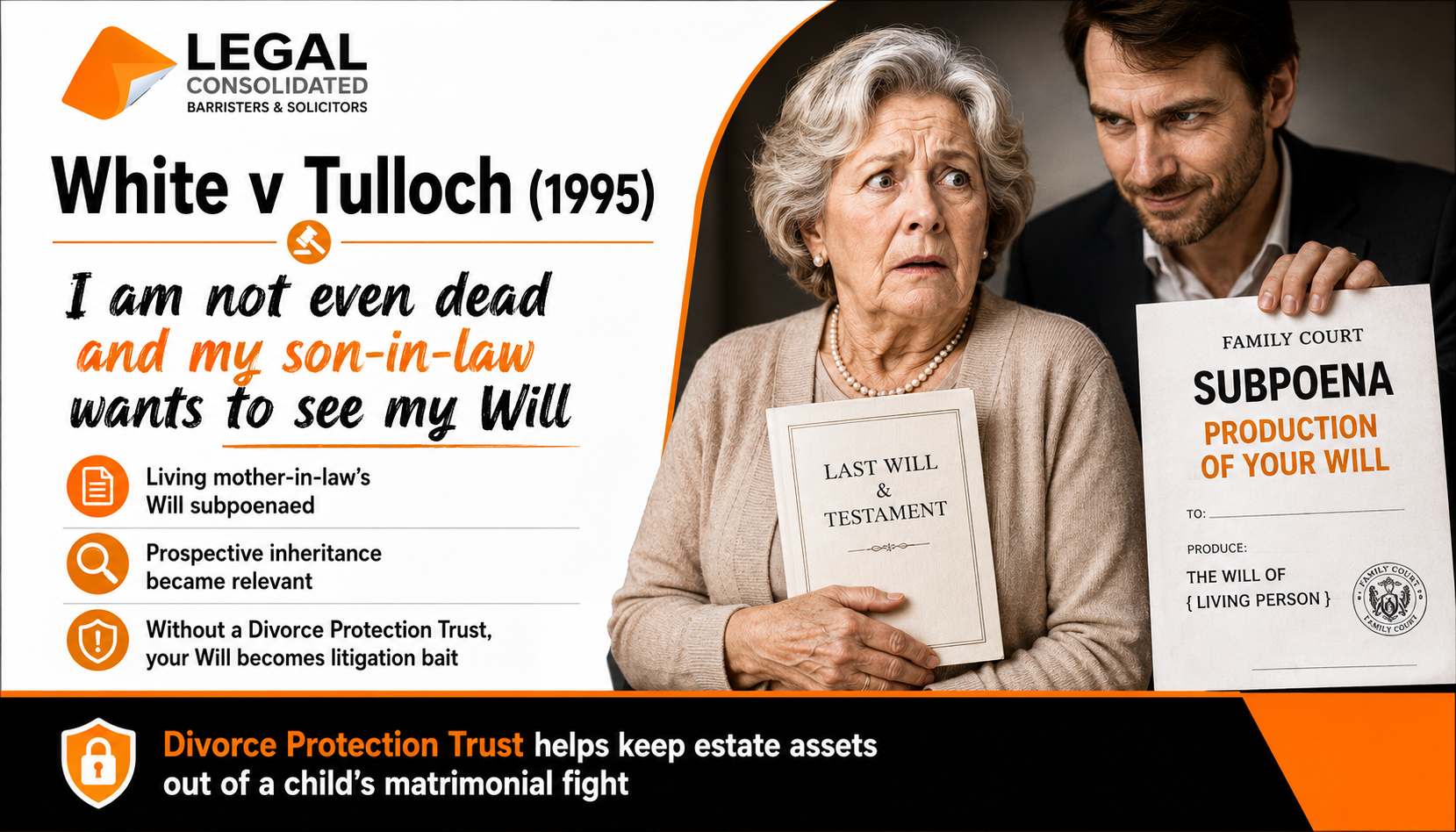
Poor old mum made a Will. At 81, she was in reasonable health. She had two children. Her Will left a likely inheritance to her daughter: the divorcing wife.
Mum’s son-in-law wanted to know what the wife may inherit. So he went after the mother-in-law’s Will.
The Family Court allowed the subpoena for the Will. Think about that. The mother-in-law was alive. Her Will had not taken effect. She could still die years later. She could still change her Will as she had the mental capacity. But the Will still became part of the Family Court fight.
That is the estate planning warning.
A possible inheritance is a financial resource. It becomes relevant if there is a worthwhile connection between the expected inheritance and the claims in the Family Court.
The Court said:
“There must be a worthwhile connection between a specific element of the party’s case and the suggested expectancy.”
That is enough to make any parent nervous.
You may think your Will is private until you die. Not always. In a child’s divorce, your Will may become evidence. Your estate planning may be dragged into your child’s matrimonial dispute before you are even dead.
What do we learn from White v Tulloch?
A direct gift in your Will is an easy target.
It tells the Family Court:
“Here is the child. Here is the inheritance. Here is the expected money.”
That is why a non-tax-effective Will is dangerous for wealthy parents. It gives no protective machinery. It just hands the inheritance straight to the in-laws. Once the child owns it, the spouse sees it. The Family Court sees it. The fight begins.
A Divorce Protection Trust in a 3-Generation Testamentary Trust Will gives the family protection. It keeps your estate assets out of your child’s exposed personal name and away from a spouse’s Family Court attack. Stop your Will from being litigation bait with a Divorce Protection Trust.
De Angelis states the same.
Dementia, a frozen Will and the Family Court: In the Marriage of De Angelis
In White v Tulloch, the Family Court looked at a living mother-in-law’s Will. That was bad enough. In the Marriage of De Angelis [1999] FamCA 1609; (2003) FLC 93-133 goes further. The expected inheritance was closer. Harder to dismiss. More dangerous.
The wife expected to inherit from her mother and her aunt. The likely inheritance included two properties. The aunt was about 90. She had dementia. She lacked the capacity to change her Will.
That matters.
A mentally healthy Will maker can update their Will. They can sell the house. They can spend the money. They can leave everything to the cat home. Until death, an inheritance is usually only an expectancy.
But when the Will maker has lost testamentary capacity, the Will is frozen. The Family Court looks harder. The child’s expected inheritance starts to look less like a vague hope and more like a future cheque.
The Full Court said there is “no absolute rule”. Each case depends on its own facts. But the Court asked whether it would be just and equitable to ignore the probability that, in what could be a very short time, the wife could own two properties worth almost as much as the existing matrimonial property.
Your child’s spouse does not need you to be dead before your estate planning becomes a target. If your Will lacks a Divorce Protection Trust, it is fixed, or you have lost testamentary capacity, the Family Court treats the expected inheritance as relevant.
What does De Angelis teach about Divorce Protection Trusts?
A simple Will leaves a clear trail:
“My child gets my estate.”
That is litigation bait. It tells the Family Court where the money is going. It tells the child’s spouse what to chase. It gives the court a clean story: the inheritance is coming, the Will maker cannot change the Will, and the child is likely to receive the asset.
A Divorce Protection Trust in a 3-Generation Testamentary Trust Will gives your family better machinery. It helps keep estate assets out of your child’s exposed personal name. It creates control levers. It makes the inheritance harder to describe as a simple cheque waiting for your child.
MacDowell v Williams (2012)
Protects from death duties, divorcing and bankrupt children and a 32% tax on super.
Build online with free lifetime updates:
Couples Bundle
includes 3-Generation Testamentary Trust Wills and 4 POAs
Singles Bundle
includes 3-Generation Testamentary Trust Will and 2 POAs
Death Taxes
- Australia’s four death duties
- 32% tax on superannuation to children
- Selling a dead person’s home tax-free
- HECs debt at death
- CGT on dead wife’s wedding ring
- Extra tax on Charities
Vulnerable children and spend-thrifts
- Your Will includes:
- Divorce Protection Trust if children divorce
- Bankruptcy Trusts
- Special Disability Trust (free vulnerable children in Wills Training Video)
- Guardians for under 18-year-old children
- Considered person clause to stop Will challenges
Second Marriages & Challenging Will
- Contractual Will Agreement for second marriages
- Wills for blended families
- Do Marriages and Divorce revoke my Will?
- Can my lover challenge my Will?
- Make my Will fair: hotchpot clauses v Equalisation?
What if I:
- have assets or beneficiaries overseas?

- lack mental capacity to sign my Will?
- sign my Will in hospital or isolating?
- lose my Will or my home burns down?
- have addresses changed in my Will?
- have nicknames and alias names?
- want free storage of my Wills and POAs?
- put Specific Gifts in Wills
- build my parent’s Wills?
- leave money to my pets?
- want my adviser or accountant to build the Will for me?
Assets not in your Will
- Joint tenancy assets and the family home
- Loans to children, parents or company
- Gifts and forgiving a debt before you die
- Who controls my Company at death?
- Family Trusts:
- Changing control with Backup Appointors
- losing Centrelink and winding up Family Trust
- Does my Family Trust go in my Will?
Power of Attorney
 Money POAs: NSW, VIC, QLD, WA, SA, TAS, ACT & NT
- be used to steal my money?
- act as trustee of my trust?
- change my Superannuation binding nomination?
- be witnessed by my financial planner witness?
- be signed if I lack mental capacity?
- Medical, Lifestyle, Guardianships, and Care Directives:
- Company POA when directors go missing, insane or die
After death
- Free Wish List to be kept with your Will
- Burial arrangements
- How to amend a Testamentary Trust after you die
- What happens to mortgages when I die?
- Family Court looks at dead Dad’s Will