-
SMSF Product Disclosure Statement and Deed Update
-
$450 includes GST
Protect your retirement savings against claims that the risks were never explained. Includes your SMSF Deed update and supporting legal documents.
Protect your retirement savings against claims that the risks were never explained. Includes your SMSF Deed update and supporting legal documents.
Legal Consolidated’s SMSF Product Disclosure Statement helps protect your retirement savings from claims that a member was never told the risks.
An investment loss hurts. A demand that you personally make good another member’s losses makes it worse. After a marriage breaks down, ‘we agreed on the strategy’ turns into ‘you never told me what I stood to lose’.
Legal Consolidated’s SMSF Product Disclosure Statement puts the risks, rights and responsibilities in writing. Give it to members and keep the delivery records. That evidence makes an allegation of inadequate disclosure harder to sustain and strengthens the position of the trustee and trusted advisers.
Your PDS comes with the complete SMSF Update. The governing rules, disclosure and trustee records are prepared together. As you build, you also confirm the trustees and members, or change them at no extra charge.
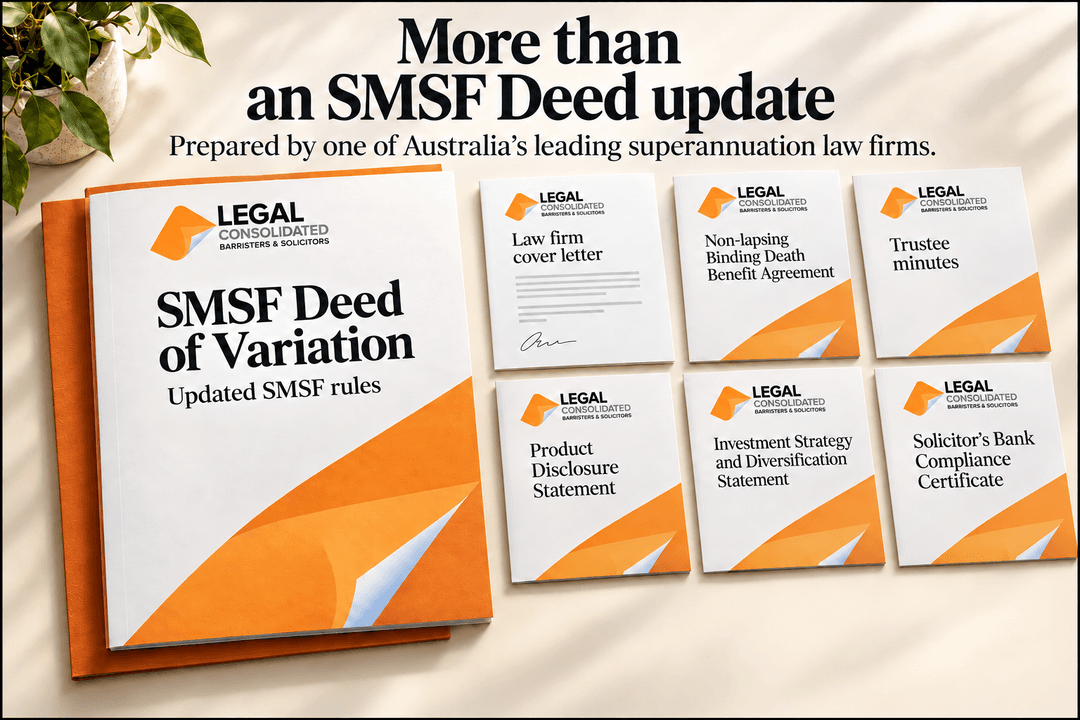
One complete SMSF Update package. You also confirm your trustees and members, or change them at no extra charge.
Our signed law firm cover letter confirms that Legal Consolidated authored your documents and takes responsibility for them. It explains the signing and implementation steps. Read the free sample before you build.
Legal Consolidated is a national Australian law firm serving Western Australia, Northern Territory, South Australia, Queensland, New South Wales, Victoria, Tasmania and the Australian Capital Territory. You build directly with the law firm that prepares your documents.
When investments rise, everybody remembers agreeing. When they fall, memories change. A member’s signature on the deed does not prove that the investment risks were explained. Legal Consolidated’s PDS gives members written information about their SMSF before a dispute gives them a reason to question it.
Your deed gives the trustee its powers. Your PDS explains members’ rights, responsibilities and risks. Your minutes record the decisions. Keep the documents and delivery records together so an allegation meets evidence, rather than a husband’s word against his wife’s.
Your trusted advisers work hard to support your retirement strategy. Clear disclosure strengthens their records and helps answer a claim that they left a member in the dark. Legal Consolidated provides the coordinated legal machinery; your advisers assess the investments and financial strategy.
The PDS supports their advice and records. It does not replace their assessment of the strategy or excuse a failure to perform a legal duty.
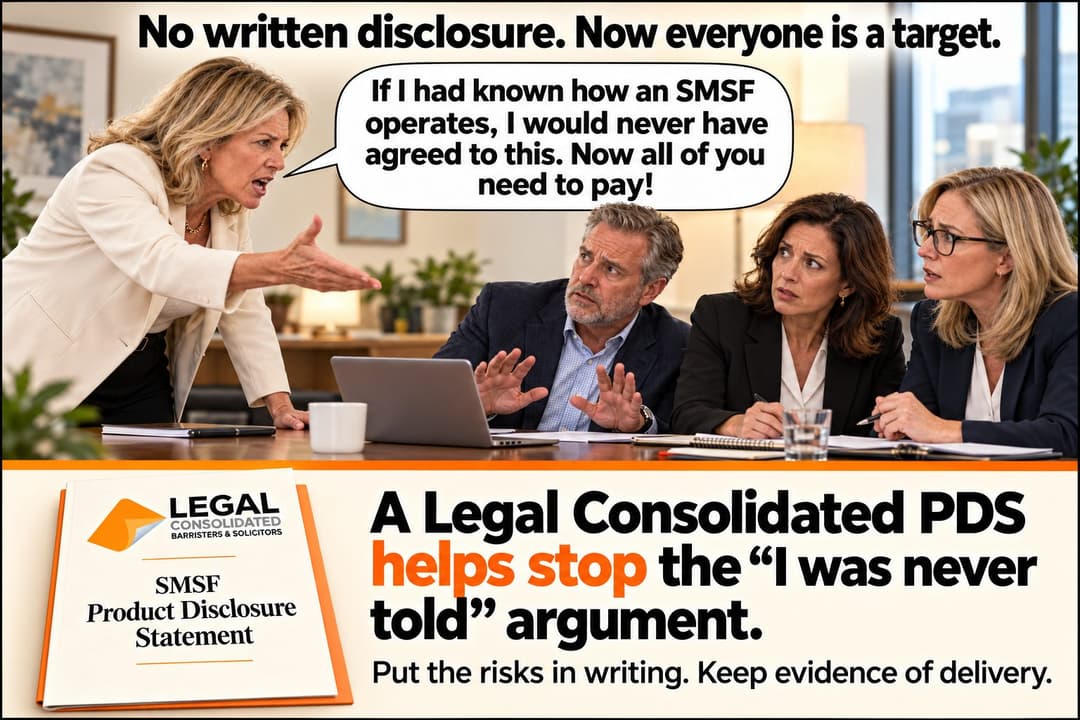
An accountant approached Legal Consolidated about a client who used his SMSF in a lawful but high-risk, leveraged investment strategy. Leverage magnifies investment exposure, including losses. After the wife left the husband, she claimed that he and ‘his’ accountant had not shared the risks with her. She said no one explained the SMSF rules to her. She wanted to be topped up for the losses.
The investment losses were now a disclosure dispute. The accountant faced an allegation about what the wife had been told, not merely an argument about how the investments had performed.
Legal Consolidated’s SMSF PDS explains investment risks, members’ rights and trustee responsibilities. Give it to members before they make investment decisions, and keep evidence of delivery. Together with your adviser’s records explaining the strategy’s specific risks, it puts written evidence behind the husband and his advisers. That makes an allegation that the risks were withheld harder to sustain.
Put that protective machinery in place while the family still agrees. A PDS does not make an unsuitable investment suitable or remove liability for misconduct. Its protection lies in proper disclosure and evidence of what members received.
Do not give a member stale disclosure and leave yourself explaining it after a loss. Update the legal documents while you still control the timing, rather than after a member demands compensation.
Where a PDS is required, Corporations Act 2001 (Cth) s 1012J requires its information to be up to date when given. Giving out-of-date information breaches that requirement. Section 1013D(1)(c) requires disclosure of significant risks, subject to the Act’s content rules. These are statutory duties, not optional housekeeping.
Disclosure failures also carry a financial sting. Section 1022B provides rights to recover loss caused by specified disclosure failures. Liability depends on the section’s requirements and available defences. An investment loss alone does not establish a compensation claim.
Your SMSF Update brings the governing rules and PDS together. Review disclosure when you update the deed, admit a member or change arrangements affecting the information members receive. Check that the actual strategy and its relevant risks are properly addressed with your accountant and financial planner.
Give members their PDS, allow time for questions and record when and how it was provided. Follow our cover letter and keep the trustee minutes and earlier versions with your fund records. An acknowledgement supports the evidence; it does not replace proper disclosure.
Clear written disclosure strengthens your fund’s records even where a disclosure exception applies. ASIC explains that the SMSF exception requires reasonable grounds to believe a person joining has received, or has and knows they have access to, all the information a PDS would contain.
Being a trustee or director does not itself establish that knowledge or access. See ASIC’s Regulatory Guide 168, [168.29]–[168.31], discussing Corporations Act 2001 (Cth) s 1012D(2A).
Have the SMSF name, address, original deed date, trustee details and member details beside you. Download the editable Word checklist and work through it with your accountant, lawyer or financial planner. Advisers are welcome to replace our logo with their own.
The educational building process is free. Read the free hints and watch the training videos as you answer the questions for your complete SMSF Update. You pay when you choose to buy the completed legal documents.
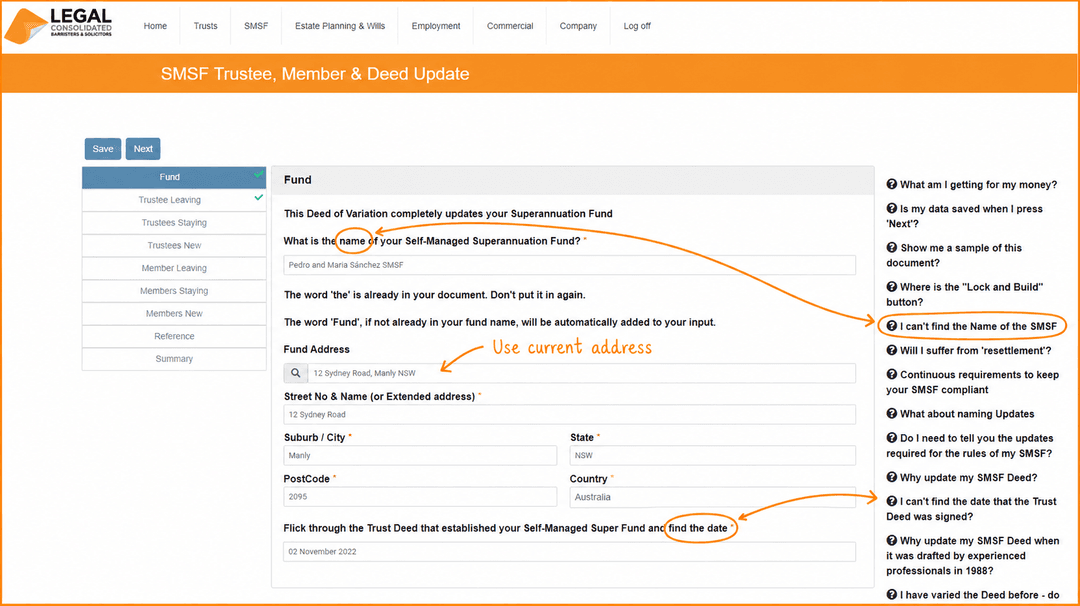
The hints beside the questions help you find the fund’s name and original deed date.
When your answers are ready, select ‘Lock and Build’, pay and download the SMSF Update. Follow our law firm cover letter for signing and implementation. Give members their PDS and keep the delivery records with the deed and trustee minutes.
For help answering a question, start building and read the hints, then telephone 1800 141 612. We help you work through your answers.
Legal Consolidated’s SMSF Deed Update is carefully crafted to update the rules of your existing fund without transferring its assets. Your fund keeps its assets while its governing rules are brought up to date. The Northern Territory has a separate nominal duty and lodgement requirement, explained below.
This guidance concerns the rules update itself. A separate transfer of fund property, declaration of trust over property or change to ownership interests needs its own duty review. If you change trustees, also check the duty and title-registration requirements for the fund’s assets.
A deed updating an SMSF’s rules is subject to Northern Territory stamp duty where the NT duty laws apply. This includes a deed executed in the NT, or a deed relating to NT property or a matter or thing done or to be done in the NT, even if signed elsewhere.
For a trust deed that is not otherwise chargeable with duty based on the value of property, the nominal duty is $20, plus $5 for each duplicate or counterpart. Lodge the deed and the required Stamp Duty Lodgement Form with the Territory Revenue Office within 60 days after the deed is first executed. Duty must also be paid within that period unless the assessment specifies a later payment date.
Postal address: Territory Revenue Office, GPO Box 1974, Darwin NT 0801. Obtain the current form from the NT Department of Treasury and Finance.
See Stamp Duty Act 1978 (NT) s 9, s 9B and sch 1 item 2.
Legal Consolidated’s rules update for a complying SMSF does not attract NSW transfer duty and does not need to be lodged with Revenue NSW for endorsement. The exemption for instruments relating to superannuation is in the Duties Act 1997 (NSW) s 65(10)(a).
A separate purchase or transfer of property is assessed under its own duty rules. The exemption for the SMSF deed does not remove those requirements.
An instrument amending the provisions governing a complying superannuation fund is exempt from Victorian duty under the Duties Act 2000 (Vic) s 39. The exemption also covers a fund that, in the trustees’ opinion, will become a complying superannuation fund within 12 months after execution.
A Legal Consolidated SMSF Deed Update satisfying those requirements does not require stamping merely because it updates the fund’s rules. Separate property transfers have their own duty requirements.
A Legal Consolidated SMSF Deed Update that varies only the fund’s general terms and conditions does not attract Queensland transfer duty and does not require stamping. Queensland Revenue Office expressly confirms this treatment for variations confined to general trust terms.
A cash contribution or cash benefit payment does not, by itself, attract Queensland transfer duty. A separate transaction involving dutiable property, such as Queensland land, requires its own assessment of duty, exemptions and concessions.
See Duties Act 2001 (Qld) ss 8–10 and the Queensland Revenue Office guidance on trusts.
A Legal Consolidated SMSF Deed Update confined to updating the fund’s governing rules, without a dutiable transaction, does not attract WA transfer duty or require lodgement for stamping.
RevenueWA’s superannuation guidance distinguishes the fund deed and its amendments from a duty-endorsed property acquisition or declaration of trust. It requests stamped copies of fund deeds and amendments where they are dated before 1 July 2008.
A separate transfer of dutiable property or declaration of trust over that property has its own duty and lodgement requirements. See Duties Act 2008 (WA) ss 11 and 23 and RevenueWA’s superannuation duty requirements.
Legal Consolidated’s SMSF Update is carefully crafted to update the fund’s governing rules without transferring its assets. A rules-only variation that does not create or vary beneficial interests in trust property is covered by the Stamp Duties Act 1923 (SA) s 71(5)(i), where the original trust instrument is duly stamped. General exemption 30 in sch 2 pt 2 also covers deeds for which no specific charge or basis for charging duty is fixed.
A rules-only update satisfying the applicable exemption does not require lodgement for duty assessment. A separate arrangement that transfers property or creates or varies beneficial interests in South Australian property needs its own duty review before signing.
A Legal Consolidated SMSF Deed Update confined to the fund’s governing rules does not attract ACT conveyance duty or require duty lodgement merely because the rules are updated. The applicable legislation is the current Duties Act 1999 (ACT), ch 2.
A separate transfer of dutiable property or declaration of trust over that property has its own duty requirements.
Superannuation trust deeds and variations dated on or after 1 July 2017 do not require stamping in Tasmania. This applies to a Legal Consolidated SMSF Deed Update signed on or after that date.
Historical deeds dated before 1 July 2017 have different stamping requirements. A separate transaction involving dutiable property also needs its own duty review. See the State Revenue Office Tasmania guidance, paragraph 1.3.
Practical legal strategies from a national tax and superannuation law firm.
Join PRUDENCE